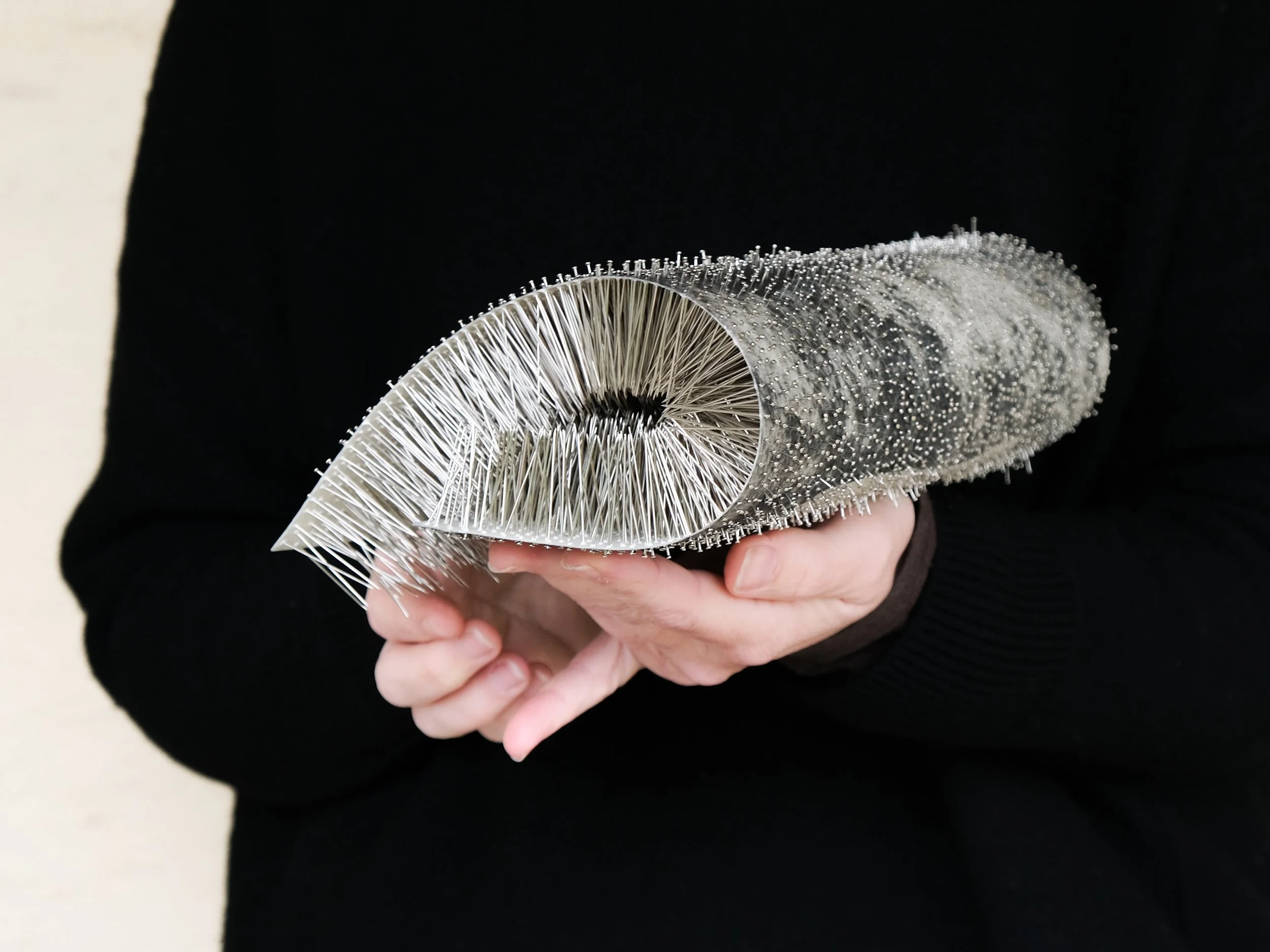
the pressure here is immense
2025
Monotype with beeswax and ballpoint pins
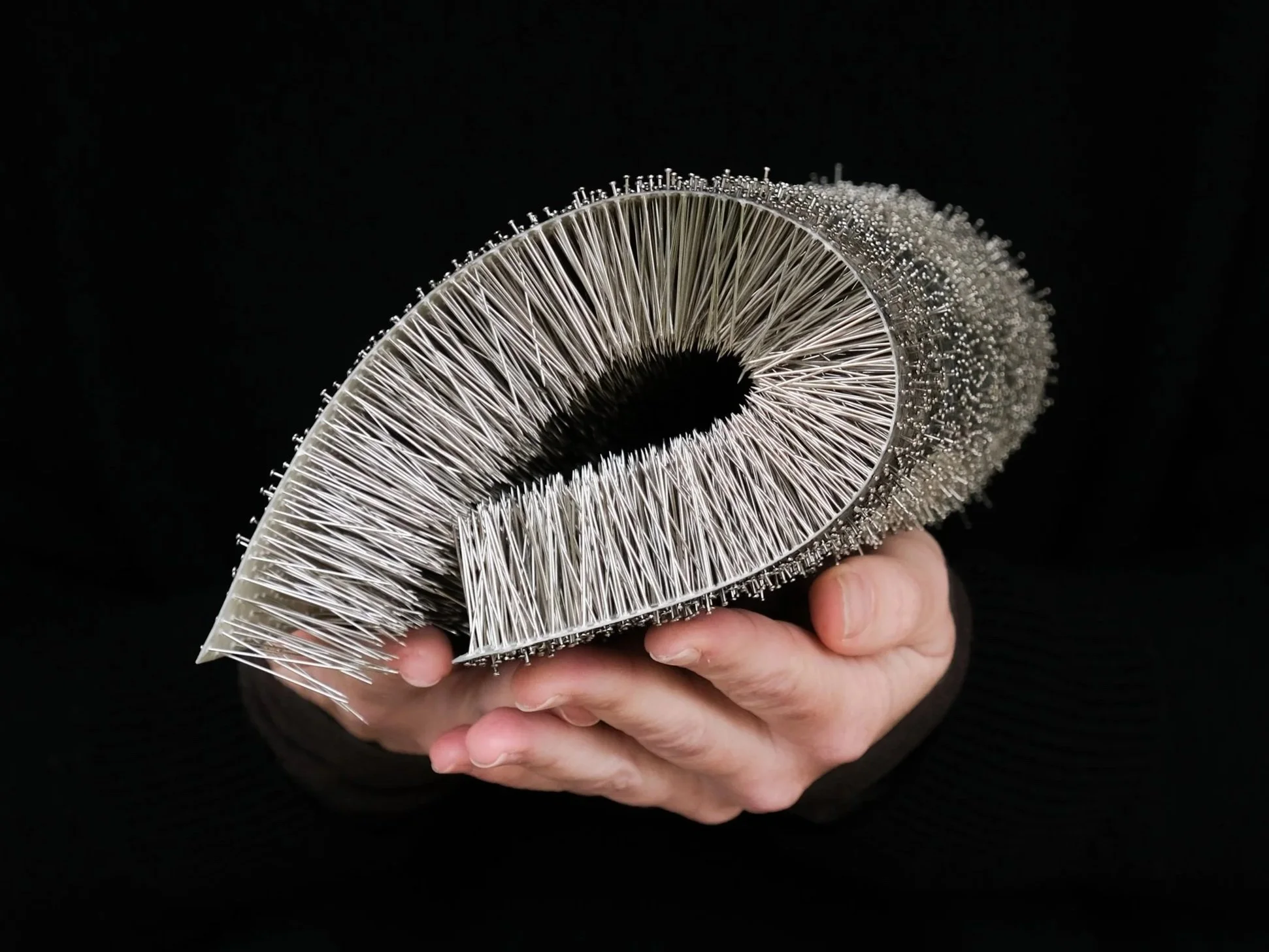
This monotype was printed from copper with chine collé on Velin Arches paper and then dipped in beeswax. The surface has been pierced with approximately 6,500 ballpoint pins. Though suprisingly flexible, it remains uncomfortable to touch.
Referencing a childhood toy that captured physical impressions, this work considers the immense pressure of memory and how that translates through multiple senses.
This work was included in the 2025 Experimental Print Print Prize at Castlemaine Art Museum and was award the overall acquisitive award.
An article about the exhibition was written by James McArdle for Imprint Magazine, ‘Among the Elements’ of which an excerpt can be found below:
August Carpenter’s recent work, The pressure here is immense (2025), might be described as barbarous. Sculptural in some ways, it erupts spikily from below through the plane of the print while, above, it sparkles, attractively jewel-like. These are unnerving contrasts. Some viewers might almost be fearful of it, cautious of a prickliness that evokes the echidna—‘viper’ to the ancient Greeks, and in Roman myth the mother of many-headed monsters.
Carpenter’s work recently won first prize in this year’s Experimental Print Prize (EPP) at the Castlemaine Art Museum in Central Victoria. The $10,000 prize is acquisitive for the first time since the biennial EPP was established in 2019. With a pool of forty-four finalists, other winners were Silvi Glattauer, who received the Highly Commended award for Dissolving Landmarks (2025), and Emily Fong, who won the Emerging Artist award for The stone on my shoulders is chasing light between boulders (2025). Michael Rigg was the inaugural financial supporter of the EPP over its first years, but other benefactors now donate the awards, so that Rigg himself has joined the finalists in 2025. The judges were Sally Foster (Curator, Prints & Drawings at the University of Melbourne) and Melissa Proposch (a local gallerist, master printer, lecturer in printmaking and drawing at RMIT, and co-founder of Castlemaine Press).
Proposch compares August Carpenter’s winning work to a centipede, some species of which inflict a mortal sting. Carpenter describes the print as arising from earlier explorations in monotype in which she investigated ‘the idea of echoes and how things bounce back and how our memories reverberate and ricochet through us at unexpected times’. Those earlier block forms—two mirrored entities—forming ‘an intense weighty presence’ carry such sensibilities into the print beneath the metal pins: ‘I ink up the plate…all in black and then modify the ink removing it for different textures…a flat print, they’re quite sculptural in their making’. That black represents Carpenter’s material research in making her own inks and the innovation, inherited from her painting training, of saturating the chine-collé kozo paper on Velin Arches in wax. It became compulsive: ‘You dip one thing in wax, then everything has to go in and nothing is safe in the studio!’
Innately curious about landscape, climate in the broadest sense, and sensory environmental experiences and spurred to comprehend the rapid Thwaites Glacier’s collapse, Carpenter won a State Library Tate Adams Memorial Fellowship to research the Keith Jackson Collection of photographs of Antarctica, Douglas Mawson diaries, maps and other materials, culminating in her Australian Galleries show The Actions of Storms. Reading explorers’ diaries and examining 100-year-old lantern slides of a world ‘ninety-nine percent of the planet will never see’, provoked continuing work on climate dissolution and unknowability.
Until recently living at Dunmoochin for two years was also transformative. The studio, aloft on a hill near the foothills of the Great Dividing Range, offered her a daily drama of weather and light. ‘I’ve never experienced light like that. The whole house would shake and whistle…the place feels very hidden within its own microclimate,’ she says. This immersion shifted her practice from a studio-bounded one to something permeable, responsive and bodily.
The pins animating her work draw on experience as a jeweller’s assistant, her sewing, and a childhood memory of a museum pinscreen that captured the imprint of her whole body. Initially functional, used to present waxed prints, here they were a reaction to a period of upheaval—‘the two weeks before we had to move house…several other stressful things…I just kept putting more pins in and then discovered: “Well, that’s all my pins!”’. The compulsion acknowledged mounting anxiety in herself and in society. Pressure was not an artistic burden but existential. ‘I don’t feel a pressure on myself as an artist to produce work but I do feel a pressure on myself to exist… climate pressure, political pressure… it’s immense.’
The experiment thus materialises psychological and environmental forces. Carpenter notes that heavy weighted sensations, even the comfort some people find in weight, informed the haptic push of pins through wax-hardened paper. She delights in the sculpture’s flexibility and its unexpected glitter under CAM’s lights—qualities that counter the brutality of its making.
Carpenter’s artwork titles are never ambivalent, but as potent in metaphor as the art itself. ‘I spend a lot of time thinking and a lot of time hoarding words in sketchbooks full of mind-maps of words I’m collecting, and ideas then extrapolated,’ she says. ‘I’ll jump into a series, or period, of making things until I can resolve that.’ Her titles are thus not illustrative but translational, the works, physical analogues.
Carpenter values curiosity and the influence of communal experiment at Baldessin Press where she is studio manager. ‘In my process, one thing sort of propels the next,’ she says. ‘Managing the workshop, people come to you for technical assistance and that keeps me on my toes.’ Her reaction to winning the award was mixed: ‘I’ve never won an award before. Winning hadn’t crossed my mind, just the possible opportunity to exhibit with like-minded people interested in this medium. Really, I wanted to see the exhibition more than I wanted to be in it, but working two jobs on top of my art practice to sustain it, to have some financial support is hugely appreciated, I’m very grateful. I feel privileged, but guilty that its not shared it with all of the other amazing works in this exhibition!’